How do you match a wedding band to an engagement ring?
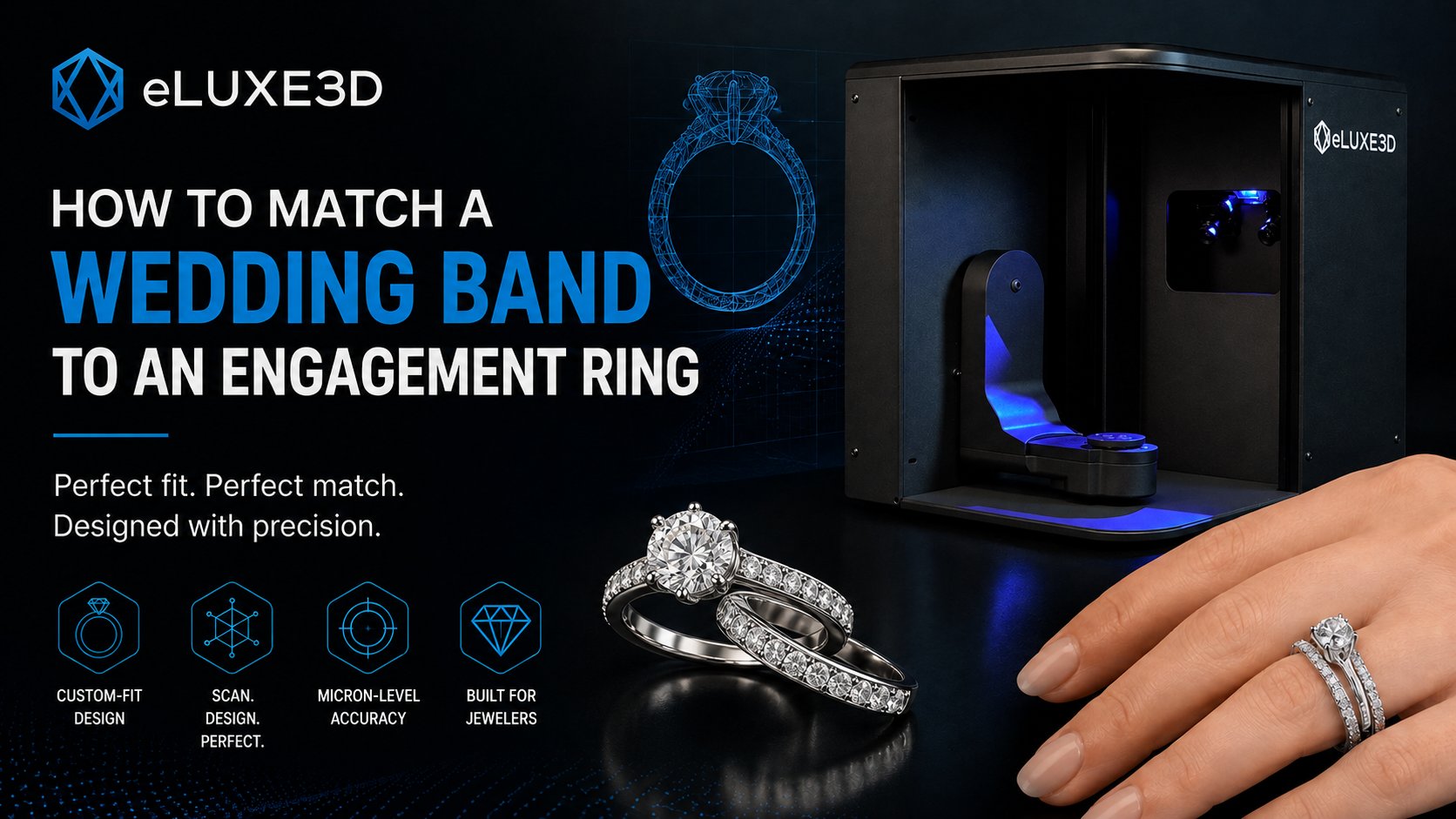
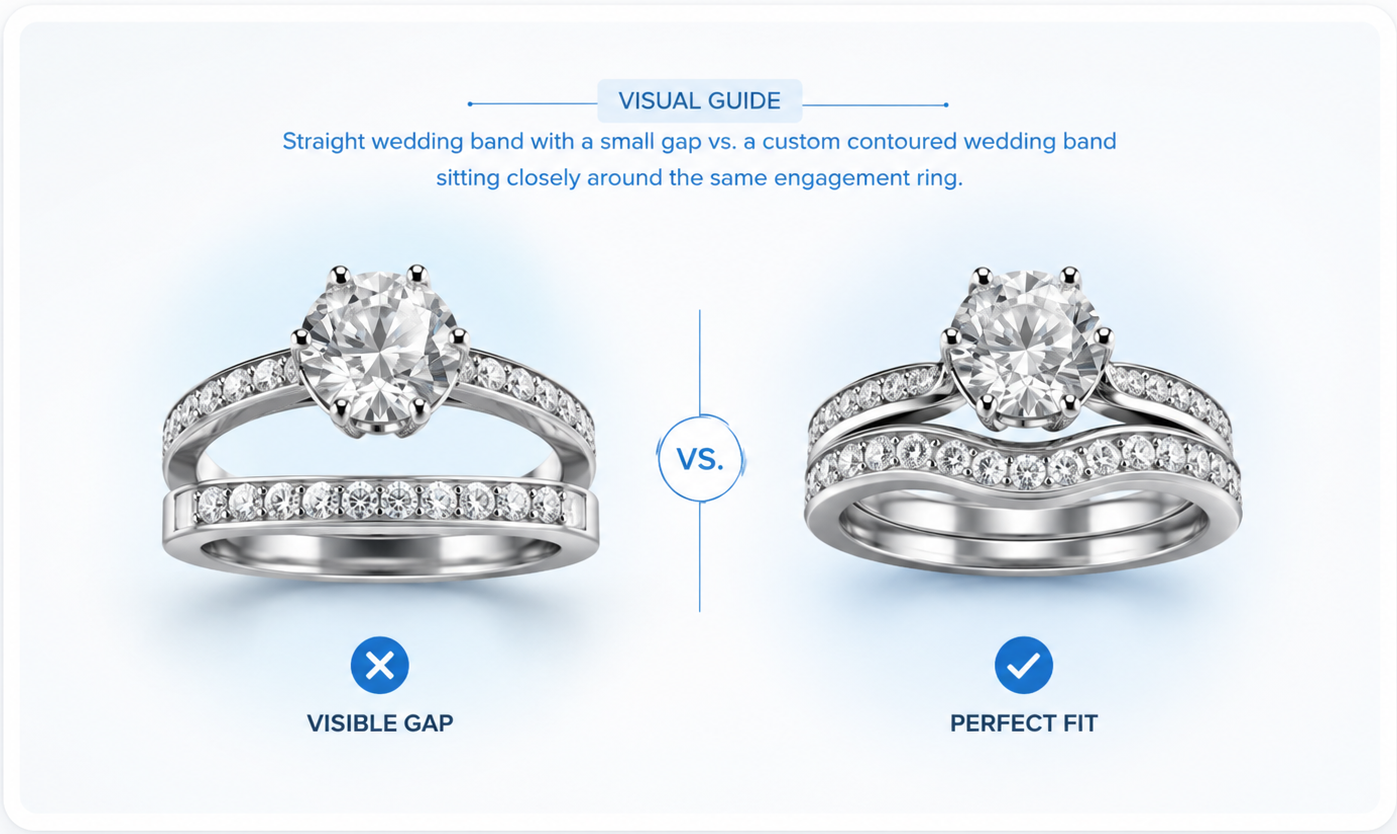
Start with the shape and physical profile of the engagement ring. If the center setting leaves enough clearance, a straight wedding band may sit flush beside it. If a halo, basket, low-set center stone, side stones, or other details extend into the space where the band needs to sit, a curved, contoured, notched, shadow, or custom-fit wedding band may be a better solution.
For jewelers, the challenge is not simply choosing a band that looks similar. It is understanding the engagement ring's actual three-dimensional geometry well enough to design a second ring that clears it, complements it, and feels intentional as a set.
Why Doesn't My Wedding Band Sit Flush With My Engagement Ring?
This is one of the most common questions behind wedding band matching. The answer usually has less to do with the wedding band itself and more to do with the architecture of the engagement ring.
A wedding band can only move as close to the engagement ring as the engagement ring's setting allows. If the head, basket, halo, gallery, prongs, side stones, or decorative elements extend beyond the shank, a straight band may physically contact those features before the two shanks meet.
Engagement ring settings can be built in many different ways. GIA, for example, describes multiple setting styles including prong, cathedral, bezel, and tension settings, each with its own construction around the center stone.[1] That construction becomes especially important once another ring needs to sit directly beside it.
A visible gap is not automatically a design flaw. Some clients prefer a deliberate space between their rings. But when the goal is a close or flush-fitting bridal set, the geometry of both pieces must work together.
What Determines Whether a Wedding Band Will Fit?
When jewelers evaluate an engagement ring for a matching band, they are looking at more than ring size. Several areas of the existing ring can determine where the wedding band can physically sit.
This is why photographs alone do not always tell the entire story. A bridal set is a three-dimensional fit problem. The top view matters, but so do the side profile, under-gallery, depth, width, and the exact points where the two rings approach one another.
Wedding Band Styles for Different Engagement Ring Shapes
There is no single wedding band style that works with every engagement ring. The right construction depends on the ring, the look the client wants, and whether the band needs to be worn separately.
Straight Wedding Band
A traditional straight band works best when the engagement ring provides enough clearance for the band to approach the shank without contacting the setting. It can create a simple, symmetrical stack and remains easy to wear on its own.
Curved or Contoured Band
A curved band follows the outside shape of the engagement ring. The curve can move around a halo, center setting, or other projection so the two rings sit closer together.
Notched Wedding Band
Instead of using one broad curve, a notched design creates a more defined recess for part of the engagement ring. This can be useful when the obstruction is concentrated around a specific area.
Shadow or Tracer Band
A shadow band is designed to echo the outline of the engagement ring. It can be subtle or dramatic, depending on how closely the jeweler wants the new piece to trace the original silhouette.
Open-Gap Band
An intentionally open design can create room around a center setting instead of forcing a continuous metal band through the same space. This can turn a clearance challenge into part of the design.
Fully Custom-Fit Band
When an engagement ring has unusual geometry or the client wants the wedding band designed specifically around the original piece, a custom band provides the greatest freedom to control the contour, spacing, proportions, stone placement, and overall flow.
A Good Match Is About More Than Closing the Gap
Physical fit is only one part of a successful bridal set. The two rings also need to look like they belong together.
Jewelers may consider the relationship between the alloy and metal color, band width, edge profile, finish, stone-setting style, stone size, spacing, and the visual weight of each ring. A highly detailed engagement ring may benefit from a quieter companion band, while a simple solitaire may leave more room for texture, diamonds, engraving, or a more expressive contour.
Proportion also affects comfort. GIA's guidance on ring stacking emphasizes maintaining balance and leaving comfortable room on the finger when multiple bands are worn together.[2] The finished set therefore needs to be considered as something that will move and be worn—not just something that looks aligned in a rendering.
Matching should be intentional, not merely identical. Two rings can use different widths, finishes, stones, or even metal colors and still feel cohesive when their proportions and geometry are designed together.
How Do Jewelers Create a Custom Wedding Band to Fit an Existing Engagement Ring?
A jeweler can create a fitted band using physical measurements, photographs, models, trial fitting, or a combination of techniques. Skilled jewelers have created matching bands this way for generations.
The difficulty is that a complex engagement ring contains far more geometry than can be represented by a few width, height, and diameter measurements. The designer still has to interpret the relationship between dozens of curves, surfaces, settings, and clearances.
That is where a digital workflow can provide a different starting point.
What does 3D scanning have to do with a wedding band?
For anyone unfamiliar with 3D scanning, think of it as a way to turn the physical engagement ring into a detailed, measurable digital reference. Instead of designing the new band from a few isolated measurements, the designer can work around the three-dimensional geometry of the actual ring.
Structured-light 3D scanners determine surface geometry by projecting a known light pattern onto an object and using cameras and triangulation to calculate three-dimensional coordinates. The underlying measurement principle is well established in dimensional metrology and has been documented by the National Institute of Standards and Technology.[3]
From Engagement Ring to Matching Wedding Band
For a jeweler or CAD designer, the scan becomes a digital reference that can stay with the project while the new band is developed.
Capture the Original Engagement Ring
The existing ring is scanned so its contours, setting, shank, under-gallery, and adjoining surfaces can be represented digitally.
Bring the Geometry Into the Digital Workflow
The resulting scan provides a three-dimensional reference that the designer can view and work around inside the CAD process.
Design the Band Around the Actual Ring
The wedding band can be shaped around the real contour instead of relying solely on an approximation reconstructed from photographs and isolated measurements.
Control Clearance, Style, and Proportion
The designer can refine spacing, curvature, profile, stone placement, and visual balance while using the engagement ring itself as the digital reference.
Move the New Design Toward Production
Once the matching band has been finalized, the new design can continue through the jeweler's normal CAD, prototyping, printing, casting, and finishing workflow.

Where eLUXE3D Fits Into the Custom Wedding Band Process
eLUXE3D is a precision 3D scanning system developed specifically for jewelry workflows. For custom-fit wedding bands, the scanner captures the existing engagement ring so the CAD designer can begin with a digital representation of the actual piece.
That changes the starting point of the project. Rather than asking, "How closely can we recreate this ring from measurements?" the designer can work from captured geometry and focus more directly on the new band's fit, style, and production requirements.
The eLUXE3D Platinum uses structured-light scanning and supports a scanning area from 25 × 40 mm to 120 × 95 mm, allowing the system to capture jewelry pieces and other small objects at the level of detail required for professional digital workflows.
For fitted wedding band projects, one of the most important advantages is what happens after the scan. Once the engagement ring has been captured, the CAD process can continue from its digital geometry, helping reduce repeated handling of a valuable or sentimental client piece.
If scanning is performed in-house, the physical ring can also remain under the jeweler's control rather than being sent to an outside provider simply to create a digital reference. That can reduce shipping, insurance, scheduling, and handoff steps in workflows that would otherwise require outsourcing.
See the complete eLUXE3D custom-fit wedding band workflow for more examples of designing shadow bands, curved bands, and companion pieces around an existing engagement ring.
Why This Matters for Jewelers Offering Custom Bridal Work
From the customer's perspective, the request sounds simple: "I want a wedding band that fits my engagement ring."
For the jeweler, that request combines design, measurement, engineering, manufacturing, customer trust, and the responsibility of working around a ring that may be both financially and emotionally valuable.
A stronger digital reference can help simplify the front end of that process. Less time needs to be spent reconstructing geometry that already exists physically, and more attention can go toward the new piece the customer is actually purchasing.
There is also a long-term wear consideration. Jewelers Mutual notes that when rings repeatedly rub against one another, the friction can contribute to wear and tear over time.[4] That makes intentional spacing and contact between a wedding band and engagement ring more than an aesthetic consideration.
The objective is not simply to make two rings touch. It is to create a bridal set whose fit, clearance, proportions, appearance, comfort, and production strategy have all been considered together.
Frequently Asked Questions About Matching Wedding Bands
What wedding band will sit flush with my engagement ring?
A straight band can sit flush when the engagement ring has enough clearance around its setting. If a basket, halo, low center setting, or side stones block that space, a curved, contoured, notched, shadow, or custom-fit band may be required.
Why is there a gap between my engagement ring and wedding band?
A gap usually occurs because part of the engagement ring extends farther outward than its shank. The wedding band contacts that setting geometry before it can move completely against the engagement ring.
What wedding band works with a low-set engagement ring?
Low-set engagement rings often pair well with curved, contoured, notched, or custom wedding bands because those designs can move around the lower basket or center setting instead of trying to pass underneath it.
Can a wedding band be custom made to fit an existing engagement ring?
Yes. A custom band can be designed around the engagement ring's actual shape. Jewelers may use physical measurements and fitting techniques, or capture the existing ring digitally so the band can be designed around its three-dimensional geometry in CAD.
What is a contour or shadow wedding band?
A contour or shadow band is shaped to follow part of the engagement ring's outline. Instead of remaining completely straight, the band curves or changes direction so it can sit closer to the engagement ring's center setting or decorative details.
Is it bad if my wedding band does not sit flush?
Not necessarily. Some bridal sets are intentionally designed with visible space between the rings. The important questions are whether the spacing looks intentional, feels comfortable, and avoids unwanted contact or interference during everyday wear.
How does 3D scanning help create a matching wedding band?
3D scanning converts the physical engagement ring into a detailed digital reference. The CAD designer can then create the new wedding band around the actual captured geometry, which can reduce reliance on manually recreating a complex ring from a small number of measurements.
See a Custom Wedding Band Workflow in Action
Seeing the process makes the concept much easier to understand. A short demonstration can show how an existing engagement ring becomes a digital reference and how that geometry carries forward into the matching-band design.
Sources & Further Reading
Technical and jewelry-industry references used in preparing this guide:
[1] Gemological Institute of America (GIA). What Is a Diamond Solitaire Setting?
[2] Gemological Institute of America (GIA). Ring Stacking Guide: How to Style and Stack Your Rings
[3] National Institute of Standards and Technology (NIST). Sources of Errors in Structured Light 3D Scanners
[4] Jewelers Mutual. What Are Soldered Rings?
eLUXE3D technical specifications. eLUXE3D Product Brochure
Design the Wedding Band Around the Ring That Already Exists
Custom-fit wedding bands are a perfect example of why accurate source geometry matters. With eLUXE3D, jewelers can capture the original engagement ring, continue the project from its digital scan, and design curved, shadow, contoured, or fully custom bands around the actual piece.
See how precision 3D scanning can fit into your custom bridal workflow.