An integrated digital manufacturing system connects every stage of jewelry production—3D scanning, CAD design, CAM programming, CNC machining or 3D printing, ERP planning, inventory, and traceability—into a single digital thread. Data flows automatically from one stage to the next, eliminating manual re-entry, catching errors before production begins, and giving manufacturers a complete audit trail from first capture to finished piece.
That’s the short answer. The longer answer is that most jewelry businesses don’t have an integrated system—they have a collection of disconnected tools held together by email attachments, USB drives, and someone’s memory. This guide explains what a truly integrated jewelry manufacturing workflow looks like, which technologies belong in it, and how to build one stage by stage.
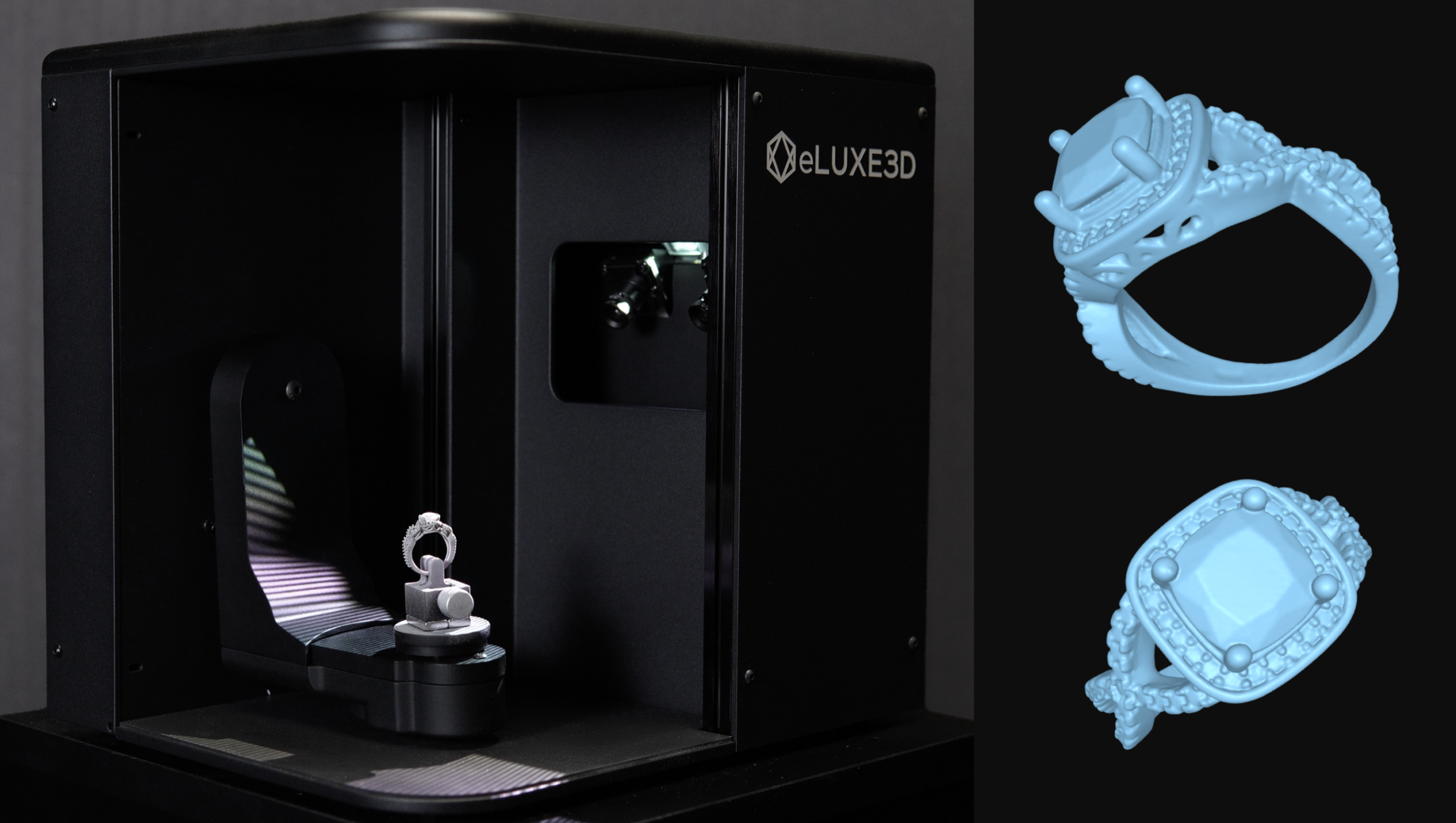
Within this broader workflow, eLUXE3D serves as the precision capture layer, supplying detailed scan data that can move into CAD and downstream production systems.

What Is an Integrated Digital Manufacturing System?
In jewelry production, an integrated digital manufacturing system means that the output of every tool becomes the input of the next—automatically, without manual file conversion or data re-entry.
A typical integrated pipeline looks like this:
Capture — A physical piece, gemstone, or model is digitized with a high-precision 3D scanner.
Design — The scan data flows directly into CAD software (MatrixGold, Rhino, ZBrush) as the geometric foundation.
Validation — Automated manufacturability checks verify wall thickness, prong strength, stone clearances, and castability before anything is produced.
Production planning — ERP and MES tools schedule the job, reserve materials, and generate work orders.
Manufacture — CAM software drives CNC mills, while slicing software prepares files for resin printers to produce castable models.
Verification — The finished casting is scanned again and compared against the digital master to catch shrinkage, warping, or surface defects.
Archive — Every version, revision, and material record is stored in a searchable digital vault.
The defining feature isn’t any single technology. It’s the digital thread—one continuous, traceable data record that follows the piece from intake to delivery.
Why does this matter? Manual data transfer between disconnected systems introduces errors at every handoff. For a shop processing dozens of custom orders a month across five or more handoff points, that compounds into remakes, missed deadlines, and material waste. Integration can significantly reduce handoff errors and shorten production time compared with workflows built around disconnected files, hand drawings, and manual processes.
Why Precise Capture Is the Foundation of the Entire System
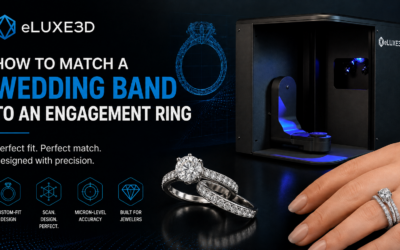
Here’s what most guides on digital manufacturing get wrong: they start at CAD. But in jewelry, the workflow almost never starts from a blank screen. It starts from something physical—a client’s engagement ring that needs a matching shadow band, an heirloom to be restored, a loose gemstone that needs a setting, or a legacy piece being reissued.
That means the first stage of your integrated system is capture, and every downstream stage inherits the quality of that capture. If your scan is off by a tenth of a millimeter, your CAD model is off, your manufacturability checks pass parts that will fail, your CNC toolpaths cut the wrong geometry, and your quality inspection compares castings against a flawed master. Garbage in, garbage everywhere.
This is why professional jewelry workflows use structured-light scanners built specifically for the scale and materials of jewelry. The eLUXE3D Platinum, for example, captures resolution down to 24 microns—finer than a human hair—using dual 8-megapixel cameras and structured-light technology, with automatic mesh cleaning, hole filling, and noise removal so the file that enters CAD is already production-ready. Reflective metals, irregular gemstones, and intricate filigree are exactly the geometries that generic scanners struggle with and jewelry-specific scanners are engineered for.
A capture stage done right gives the rest of the system three things:
True geometry Settings, bezels, and bands designed around real measurements fit on the first try instead of the third.
Clean, CAD-ready files STL, OBJ, or PLY meshes that import into MatrixGold or Rhino without hours of manual repair.
A verifiable master record The original scan becomes the reference every later version, revision, and casting is measured against.
The Core Technologies in a Modern Jewelry Manufacturing Workflow
3D Scanning: The Physical-to-Digital Bridge
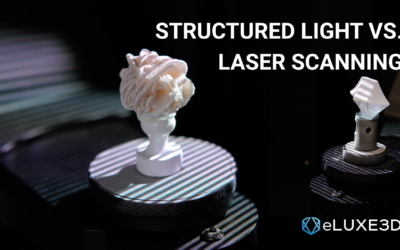
Structured-light 3D scanning converts rings, stones, and components into precise digital twins. In an integrated system, scanning is used at three points, not one:
Intake Digitize the client’s piece or stone at the counter, while the original never leaves the store.
Design reference Build new geometry—shadow bands, replacement parts, or resized pieces—directly on top of real scan data.
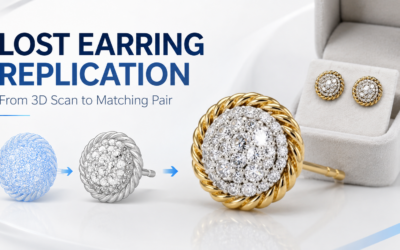
Quality verification Scan finished castings and overlay them on the digital master to detect shrinkage, warping, or surface defects before the piece reaches the client.
That third use is one of the most underused advantages of an integrated workflow: the same scanner that starts the job also closes the quality loop.
CAD: Parametric and Organic Design
CAD and digital sculpting software—including MatrixGold, Rhino, ZBrush, and Blender for organic work—turns scan data and design intent into precise 3D models. Integration matters here in two directions: clean scan meshes coming in, and manufacturing-aware files going out—with correct wall thicknesses, stone seats, and sprue considerations already modeled.
CAM and CNC: From Model to Machine
Computer-aided manufacturing software translates CAD models into toolpaths for CNC mills and instructions for high-resolution resin printers. In an integrated environment, CAM pulls geometry directly from the approved CAD revision—not from an email attachment that may or may not be the latest version. That single change eliminates one of the most expensive error classes in jewelry production: machining the wrong revision.
ERP and MES: The Operational Backbone
Enterprise resource planning systems—jewelry-specific platforms like PIRO, JewelSteps, or JewelryAdmin—handle what the design tools don’t: order management, production scheduling, costing, precious-metal tracking, and vendor management. Manufacturing execution systems (MES) sit closer to the bench, tracking each job’s real-time stage. When ERP is connected to the design pipeline, a finished CAD approval automatically generates the work order, reserves the gold, and schedules the caster.
Inventory and Digital Archiving
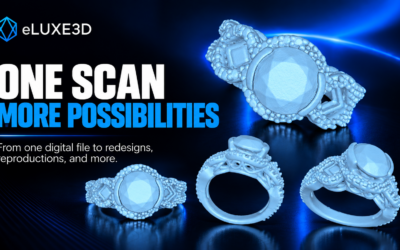
An integrated system maintains a high-resolution digital vault of every piece ever scanned or designed—inventory, heirlooms, and past commissions. This serves insurance documentation, instant re-orders, resizing without re-scanning, and searchable design reuse. For a custom shop, the archive compounds in value every year: a five-year-old scan of a client’s engagement ring means their anniversary band starts from perfect data, not a new appointment.
Traceability Tools
Traceability closes the system. Every material lot, stone certificate, revision, and approval is linked to the job record. When a client, insurer, or auditor asks, “What exactly is in this piece and who approved each step?” the answer takes seconds, not a filing-cabinet search.
Version Control, Audit Trails, and Material Tracking: The Operational Layer
This is where integrated systems separate themselves from “we use CAD and a spreadsheet.”
Version control
Version control means every design revision is stored, numbered, and recoverable. When the client approves version 4 but the bench receives version 3, you eat the remake cost. In an integrated workflow, the approved revision is flagged in the system and it’s the only file CAM can pull. Older versions remain archived for reference but can’t accidentally enter production.
Audit trails
Audit trails record who did what, when: scan captured, design revised, client approved, manufacturability check passed, work order issued, and casting verified. This isn’t bureaucracy—in a business that handles other people’s diamonds and heirlooms, it’s liability protection and client trust in database form.
Material tracking
Material tracking follows precious metals and stones through every stage. Integrated systems log metal weight at issue and return, flag variance beyond tolerance, and tie every stone to its certificate and its setting job. Combined with scan-based digital records of client pieces, this creates end-to-end custody documentation: you can prove the ring that left is the ring that arrived.
Stage-by-stage production management
Stage-by-stage production management means the system always knows where each job is—scanned, in design, awaiting approval, queued for casting, in finishing, or in QC. Bottlenecks become visible in a dashboard instead of being discovered when a deadline is missed.
Workflow Automation and Manufacturability Checks: Catching Errors Before Production
The highest-ROI feature of an integrated system is the ability to fail cheaply—on screen—instead of expensively, in metal.
Automated manufacturability checks run against the CAD model before anything is produced:
- Minimum wall thickness for the chosen metal and casting method
- Prong dimensions and stone seat clearances
- Sprue placement and castability analysis
- Weight and material cost estimation against the quote
- Interference checks between components
Workflow automation handles the connective tissue humans forget: when a scan finishes, the cleaned mesh lands in the designer’s queue; when a design is approved, the work order generates itself; when a casting is verified against its master scan, the client notification goes out. None of these steps is hard—but each one, done manually, is an opportunity for delay or error, multiplied across every job in the shop.
Shops that implement pre-production validation consistently report higher first-prototype success rates compared to manual methods—which translates directly to fewer client return visits, faster turnarounds, and less scrapped material.
How to Build an Integrated Workflow Without Replacing Everything at Once
You don’t need to buy an entire stack in one quarter. The practical sequence for most jewelry businesses:
Start with capture. A professional 3D scanner is the highest-leverage first investment because it feeds every other stage and delivers standalone value immediately—shadow bands, heirloom replication, and digital archiving—even before deeper integration.
Connect capture to CAD. Ensure your scanner outputs clean, CAD-ready meshes that your design software imports natively. This single connection eliminates the most common friction point in jewelry digitization.
Add manufacturability checks. Before investing in ERP, add design validation—it’s cheaper and it prevents the most expensive error class.
Layer in ERP/MES. Once design-to-production is digital, connect scheduling, materials, and costing.
Close the loop with scan-based QC. Use your scanner to verify castings against digital masters—the final integration that most shops never implement, and one of the strongest competitive differentiators.
At each step, pick tools with open file formats (STL, OBJ, PLY) and documented integrations. A “system” that locks your data into proprietary formats isn’t integrated—it’s captive.
The Business Case: What Integration Actually Changes
Digital workflows shorten production time massively versus hand carving and manual measurement—from weeks to days for many custom pieces.
First-try fit for bands, settings, and replacement parts designed on real scan geometry.
Clients watch their ring scanned in structured light and see a high-resolution model in minutes—visible precision that answers the silent question, “Will this fit perfectly?”
Audit trails, custody records, and digital masters protect against disputes, loss claims, and quality escapes.
The digital archive and automated workflows let a small team handle volumes that would otherwise require more staff.
Digital manufacturing isn’t replacing craftsmanship in jewelry—it’s removing everything that isn’t craftsmanship: the re-measuring, the re-entering, and the re-making. The artisan’s time goes into design and finishing; the system handles the data.
Ready to Build Your Digital Thread from the First Stage?
The eLUXE3D Platinum captures jewelry and gemstones at up to 24-micron resolution with dual 8MP cameras and delivers clean, CAD-ready files that plug directly into your design workflow.
Schedule a Demo See the capture-to-verification loop in action.