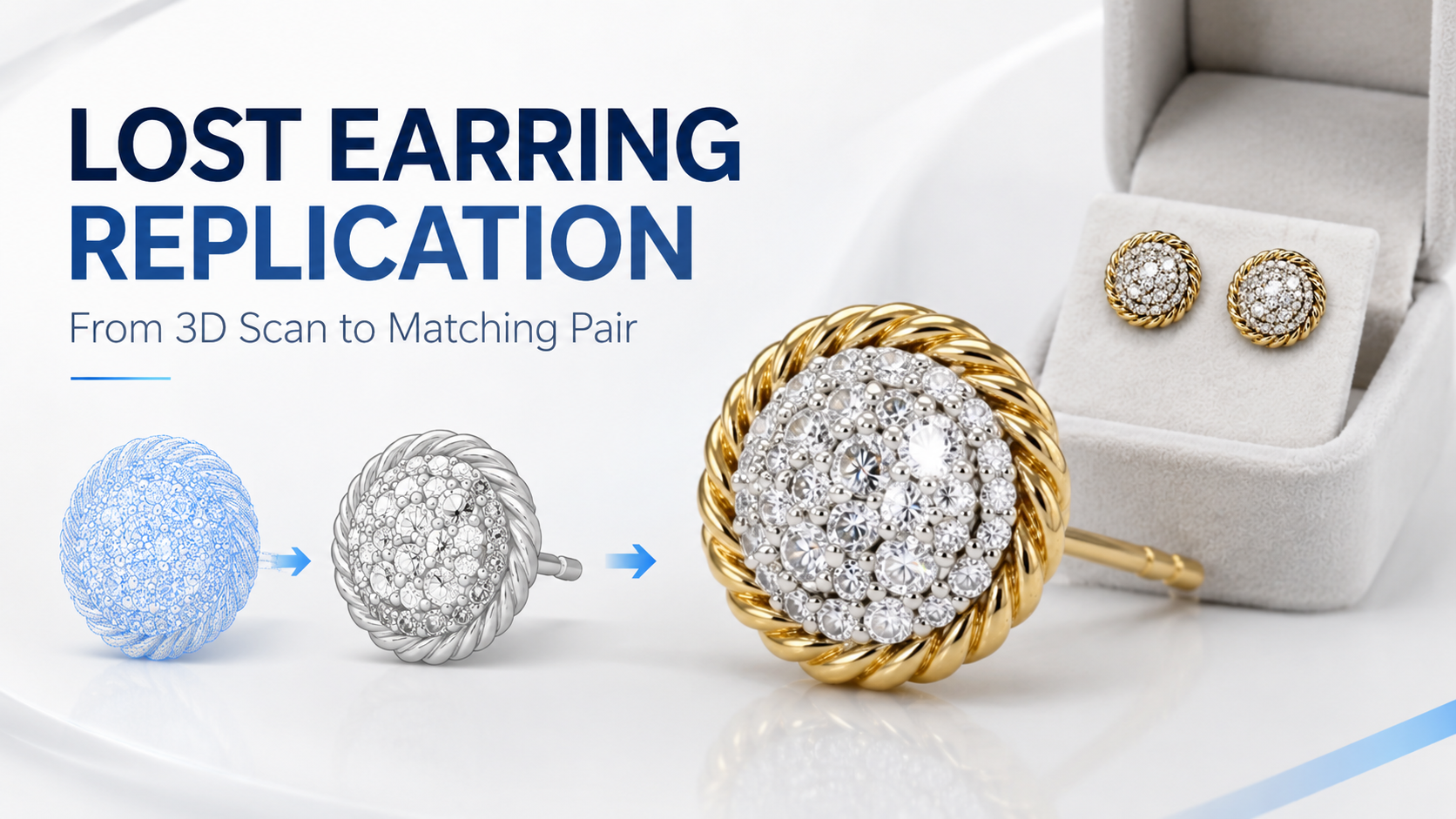
Losing one earring from a favorite pair is frustrating.
Losing one earring from a favorite pair is frustrating. For many customers, it usually means one of two things: buy an entirely new set, or place the remaining earring in a drawer where it may never be worn again.
But with eLUXE3D scanning technology, that single remaining earring can become the starting point for a precise digital recreation. Instead of guessing proportions, manually measuring every detail, or trying to recreate the design from photos alone, jewelers can now capture the existing earring in 3D and use that scan data as the foundation for a manufacture-ready replacement.
This process allows the jeweler, designer, and manufacturer to work from the actual physical object, helping recreate the lost earring with the correct shape, scale, stone layout, and design details.
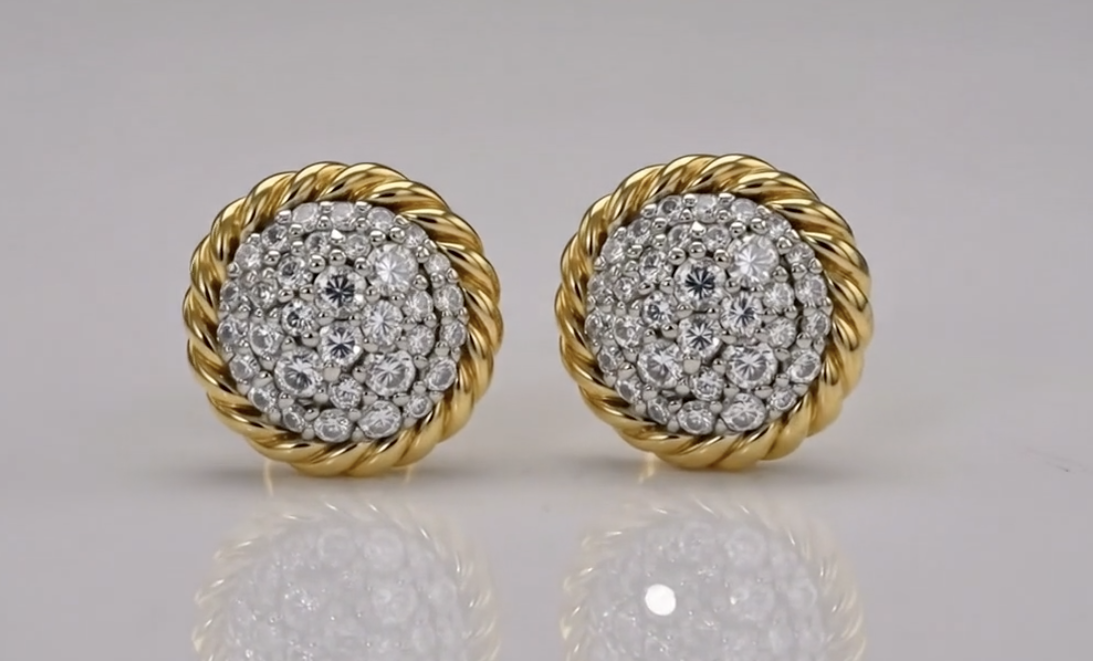
The Problem: One Lost Earring Usually Means the Pair Is Gone
Almost everyone has experienced losing an earring. It may be from a favorite everyday pair, a sentimental gift, an heirloom piece, or a custom design that is no longer available.
The remaining earring still has value, but without its match, it often becomes unusable. Traditional replacement methods can be difficult because the jeweler must manually interpret the design, measure the stones, estimate the shape, and try to recreate the piece by hand or from limited photos.
This can be time-consuming, inconsistent, and difficult to reproduce accurately, especially when the earring has complex curves, small stones, unique settings, engraved details, or organic design elements.
The Solution: Scan the Existing Earring and Recreate the Missing Match
With an eLUXE3D scanner, the jeweler can digitally capture the remaining earring in high detail. The scan creates a 3D reference of the original piece, giving the designer an accurate digital template to work from.
The scanner does not replace the designer. Instead, it gives the designer a much better starting point. The scan data provides the physical proportions, geometry, shape, and visual reference needed to recreate the earring more accurately and efficiently.
From there, the designer can build a clean, manufacture-ready CAD model that matches the original earring and can be sent directly to production.
The Lost Earring Replication Process
Step 1: The Customer Brings in the Remaining Earring
The process begins when the customer brings the existing earring to a local jeweler that has an eLUXE3D scanner.
Instead of telling the customer that the pair cannot be matched or that they need to buy a new set, the jeweler can offer a modern replacement solution: digitally capture the remaining earring and reproduce the missing one.
This creates a powerful service opportunity for jewelers and a better experience for customers.
Step 2: The Earring Is 3D Scanned
The jeweler places the remaining earring into the eLUXE3D scanner and captures the piece from multiple angles.
During the scanning process, images and scan data are collected to document the design. These images help show important visual details such as stone placement, prong style, surface texture, curves, and overall appearance.
The scan provides the designer with a digital 3D reference of the actual earring, not just a photo or a sketch.
Step 3: Scan Data and Images Are Sent to the Designer
Once the scan is complete, the jeweler sends the 3D scan data and supporting images to a CAD designer.
The designer uses the scan as a guide or digital template. This allows them to understand the exact proportions and design language of the original earring before rebuilding it in CAD.
Rather than starting from scratch, the designer is working from the real object.
Step 4: The Designer Builds a Manufacture-Ready CAD Model
The designer uses the scan data to create a clean, production-ready CAD model of the replacement earring.
This step includes matching the shape, scale, stone layout, setting style, and design details of the original piece. The stones can be measured, the settings can be recreated, and the overall structure can be built to match the existing earring as closely as possible.
The final CAD file is not just a visual model. It is a manufacture-ready 3DM file that can be used for production.
Step 5: The CAD File Is Sent to Manufacturing
Once the CAD model is complete and approved, the 3DM file can be sent to the manufacturer.
The replacement earring can then be produced using the appropriate jewelry manufacturing process, including 3D printing, casting, stone setting, polishing, and finishing.
The goal is to create a finished replacement that matches the customer’s original earring and allows the pair to be worn again.
Why This Matters for Jewelers
Lost earring replication is a simple, relatable service that customers immediately understand.
Most customers do not know that this is possible. They assume that once one earring is lost, the pair is gone forever. By offering 3D scanning and digital replication, jewelers can turn a frustrating customer problem into a high-value custom service.
This also gives jewelers a reason to re-engage customers who may already have single earrings sitting at home. A customer may have a loose diamond earring, a sentimental gold earring, or a discontinued designer piece that they have not worn in years because the match is missing.
With eLUXE3D, that single earring can be captured, recreated, and brought back to life.
A Faster, More Accurate Way to Recreate Jewelry
Traditional jewelry replication can require manual measurements, hand sketches, multiple revisions, and guesswork. eLUXE3D helps streamline that process by giving the jeweler and designer a digital record of the physical piece.
In many cases, the scan and CAD process can be completed quickly, allowing the replacement project to move into manufacturing within days, or even faster depending on the complexity of the design and the production workflow.
The result is a more efficient process for the jeweler, a better reference for the designer, and a more confident experience for the customer.
From One Earring to a Complete Pair Again
The lost earring replication process is a perfect example of how 3D scanning is changing modern jewelry services.
A customer walks in with one remaining earring. The jeweler scans it. The designer recreates it in CAD. The manufacturer produces the replacement. The customer gets their complete pair back.
What used to feel like a lost cause can now become a straightforward digital jewelry workflow.
With eLUXE3D scanning technology, jewelers can offer customers a practical, emotional, and highly valuable service: restoring the jewelry they thought they could no longer wear.
Process Flow Summary
- Customer loses one earring and brings the remaining earring to a jeweler.
- The jeweler scans the existing earring using an eLUXE3D scanner.
- Images and 3D scan data are captured during the scanning process.
- The scan data and images are sent to a CAD designer.
- The designer uses the scan as a digital guide to recreate the earring.
- Stones, dimensions, settings, and design details are matched to the original.
- A clean, manufacture-ready 3DM CAD model is created.
- The CAD file is sent to the manufacturer.
- The replacement earring is produced, finished, and delivered.
- The customer can wear the complete pair again.
The Takeaway
Lost earrings do not have to stay lost forever.
With eLUXE3D scanning technology, jewelers can digitally capture an existing earring, recreate the missing match, and deliver a modern custom jewelry experience that customers immediately understand.
It is practical, emotional, and easy to explain — and it gives jewelers another powerful way to use 3D scanning as a revenue-generating service.
Have an earring or jewelry piece you thought could never be matched? Connect with our team to explore what eLUXE3D scanning can make possible.
Connect With Our Team