How 3D Scanning Improves Shadow Band Sizing Accuracy
For generations, the art of crafting and fitting shadow band wedding rings has relied on meticulous craftsmanship and time-honored techniques. While tradition holds its value, modern expectations of precision, turnaround speed, and security have fundamentally changed what customers demand—and what jewelers must deliver.
Historically, jewelers faced a consistent challenge: creating a perfectly contoured band to match a unique engagement ring. This traditionally required sending cherished rings off-site, relying on manual caliper measurements, and working through lengthy, labor-intensive processes—all of which introduced risk, time delays, and potential inaccuracy.
Today, 3D scanning technology is transforming this process. It enables jewelers to capture ultra-fine details of a ring quickly, safely, and with exceptional precision—often without the ring ever leaving the customer’s sight. This whitepaper explores how 3D scanning is modernizing shadow band sizing by improving accuracy, efficiency, customer confidence, and overall workflow.
To see how jewelers are using this technology in real environments, visit our eLUXE3D Scanner page.
The Limitations of Traditional Shadow Band Sizing
Before advanced digital tools were available, jewelers commonly struggled with:
Human-Dependent Measurement Variability
Calipers, mandrels, and hand-measurement tools rely entirely on operator skill. Even highly experienced artisans may struggle to capture subtle curves, undercuts, micro-angles, or complex design geometries perfectly—leading to adjustments, reworks, or “close-enough” fits.
Logistical Risk and Customer Anxiety
Shipping sentimental rings off-site introduces real emotional and practical risks. Loss, damage, insurance, and uncertainty can create unnecessary tension—often at a highly emotional time for the customer.
Long Turnaround Times
Manual mold-making and analog workflows take time. Time away from other work increases labor investment and can slow overall shop output and revenue capacity.
These methods established the foundation of the craft, but they do not fully meet today’s expectations for precision, security, and efficiency.
Introducing Micron-Level Digital Precision
Modern optical 3D scanners generate highly detailed, three-dimensional digital models of jewelry pieces. For shadow bands, this means:
High Precision (Micron-Level Accuracy)
Modern scanners capture incredibly fine geometry, contours, and structural nuances. This supports extremely accurate shadow band design and significantly reduces fit issues or rework.
Speed and Efficiency
Scanning typically takes minutes, producing a usable digital file almost immediately. What previously required extended handling and multiple iterations can now be accomplished in a fraction of the time.
Direct CAD Integration
3D scans export as CAD-ready files, enabling jewelers to design in professional software and seamlessly transition to CAM or additive manufacturing workflows. Digital files can also be shared instantly with collaborators or off-site partners when needed.
Benefits for the Progressive Jeweler
Enhanced Customer Trust & Experience
- No need to surrender their original ring for extended periods
- Lower perceived risk, higher comfort level
- Faster delivery timelines and a more professional, modern experience
Operational Efficiency
- Less manual measuring and reworking
- More productive shop time
- Improved workflow integration with CAD/CAM and 3D printing
Consistent Quality
- Repeatable, digital accuracy helps eliminate inconsistencies
- Reliable, reliable fits reduce material waste and labor adjustments
- Digital archives enable replication when needed
Business Growth & Competitive Advantage
- Demonstrates innovation and professionalism
- Differentiates your shop in a competitive market
- Opens doors to new service offerings and revenue streams
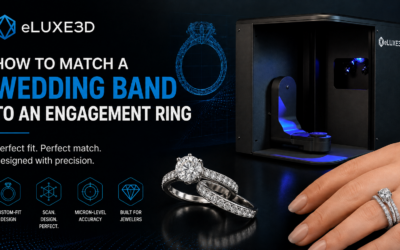
A Simple, Modern Workflow
Scan
Place the ring in the scanner and capture a precise 3D digital model within minutes.
Design
Import the file into CAD software to create an exact shadow band design.
Produce
Manufacture using traditional methods, casting, or modern digital production tools.
Scanner Comparison Overview
Below is a simplified market snapshot of several leading jewelry-appropriate 3D scanning solutions:
Artec Micro II
High precision, premium pricing
Revopoint Mini 3D
Entry-level option with accessible cost
Thunk3D JS500
Mid-range performance and price
D3D-S Models
Competitive accuracy in a moderate price range
eLUXE3D Platinum
Strong balance of precision, scanning range, pricing, and U.S.-based support
Why Many Jewelers Choose the eLUXE3D Platinum
The eLUXE3D Platinum offers:
- Excellent precision suitable for fine jewelry applications
- A generous scanning range supporting rings, pendants, and larger pieces
- Broad compatibility with leading jewelry CAD systems
- Hands-on training and U.S.-based technical support
- Strong value relative to ultra-high-end scanners with significantly higher costs
For many jewelers, it delivers an ideal balance of capability, affordability, and reliability.
Conclusion: Future-Proofing the Craft
The jewelry world continues to evolve, and customers increasingly expect innovation, accuracy, and reassurance. 3D scanning is not simply an “upgrade”—it is a strategic investment in precision, efficiency, and customer confidence.
By integrating modern scanning technology into shadow band workflows, jewelers reduce risk, accelerate production, deliver consistently superior results, and position themselves as forward-thinking leaders.
The future of fine jewelry is digital—and it’s already here.
Learn more about how professional scanners are used in jewelry manufacturing in our Resources Library.