Connecting with the jewelry industry, advancing digital workflows,
and exploring what precision 3D scanning can make possible.
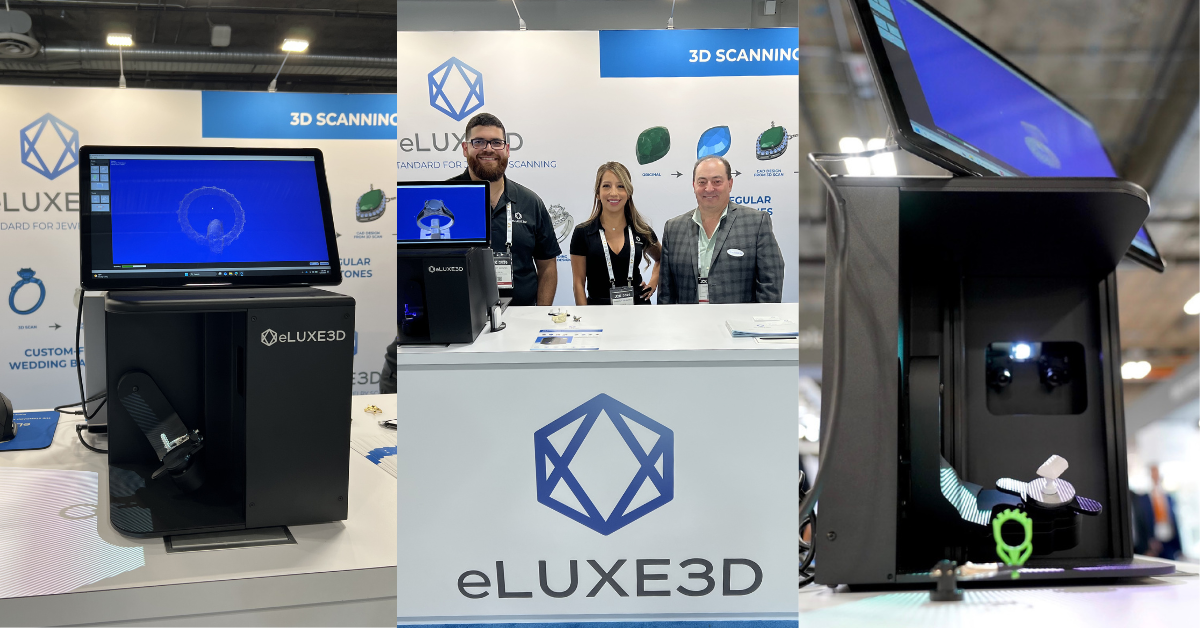
From May 29 through June 1, the jewelry industry gathered once again at The Venetian Expo for JCK Las Vegas 2026—and eLUXE3D was proud to be part of it.
JCK brings together jewelers, designers, manufacturers, technology providers, retailers, and industry leaders from around the world. For our team, the show offered another valuable opportunity to demonstrate eLUXE3D technology in person, discuss real production challenges, and connect directly with the professionals shaping the future of jewelry design and manufacturing.
Most importantly, we want to thank everyone who visited the eLUXE3D booth.
Whether you watched a demonstration, brought us a piece to discuss, asked about incorporating scanning into your workflow, or simply stopped by to learn more, we appreciated every conversation.
More Than a Demonstration
Trade shows provide something that websites, brochures, and videos cannot fully replace: the opportunity to see a technology operating within the context of a real jewelry workflow.
At JCK 2026, visitors were able to explore how eLUXE3D transforms physical jewelry, gemstones, and components into highly detailed digital models that can be imported into CAD and used as the foundation for design, manufacturing, reproduction, and documentation.
The conversations at our booth were not limited to scanner specifications. Jewelers wanted to understand what scanning could change inside their businesses.
How much time could it save?
Could it reduce the number of revisions required during custom projects?
Could valuable customer pieces remain safely in the store instead of being shipped?
Could scanning help preserve an heirloom before it is repaired or redesigned?
Could a studio bring work in-house that it currently outsources?
These are the questions that matter because technology only becomes valuable when it solves a real operational problem.
Jewelry Technology Continues to Evolve
The jewelry industry has always evolved alongside its tools.
Hand fabrication, casting, CAD design, 3D printing, laser welding, digital rendering, and precision scanning have each changed how professionals approach their work. The continued development of digital tools does not signal the end of traditional craftsmanship. It represents its progression.
Technology does not replace the trained eye of the jeweler, the judgment of the bench professional, or the creativity of the designer. Instead, it gives skilled professionals better information and more precise starting points.
A scanner cannot decide what a meaningful heirloom should become. It cannot understand a customer’s story, develop a creative concept, or apply the finishing details that distinguish exceptional work.
What it can do is capture complex geometry accurately, reduce repetitive measuring, and give the craftsperson a dependable digital foundation from which to work.
The result is not craftsmanship versus technology. It is craftsmanship supported by technology.
As digital jewelry workflows continue to advance, businesses that understand how to combine both will be better equipped to meet growing expectations for customization, accuracy, speed, and consistency.
Continued Development of the eLUXE3D Workflow
At eLUXE3D, development does not stop when a scanner enters production.
Our technology and software workflow continue to be refined with the goal of making precision scanning more practical, efficient, and accessible for jewelry professionals. These improvements are focused on the experience surrounding the scan—from capturing the object and processing its geometry to preparing usable files for CAD and production.
That ongoing development is important because jewelry technology cannot remain static while the needs of designers and manufacturers continue to change.
Custom projects are becoming more complex. Customers expect faster turnaround times. Manufacturers are being asked to maintain tighter tolerances. Businesses are also looking for ways to complete more work without creating unnecessary labor, material waste, or production delays.
A modern scanning system must therefore provide more than an impressive image. It must support a repeatable process that fits into day-to-day production.
One Scanner, Many Jewelry Applications
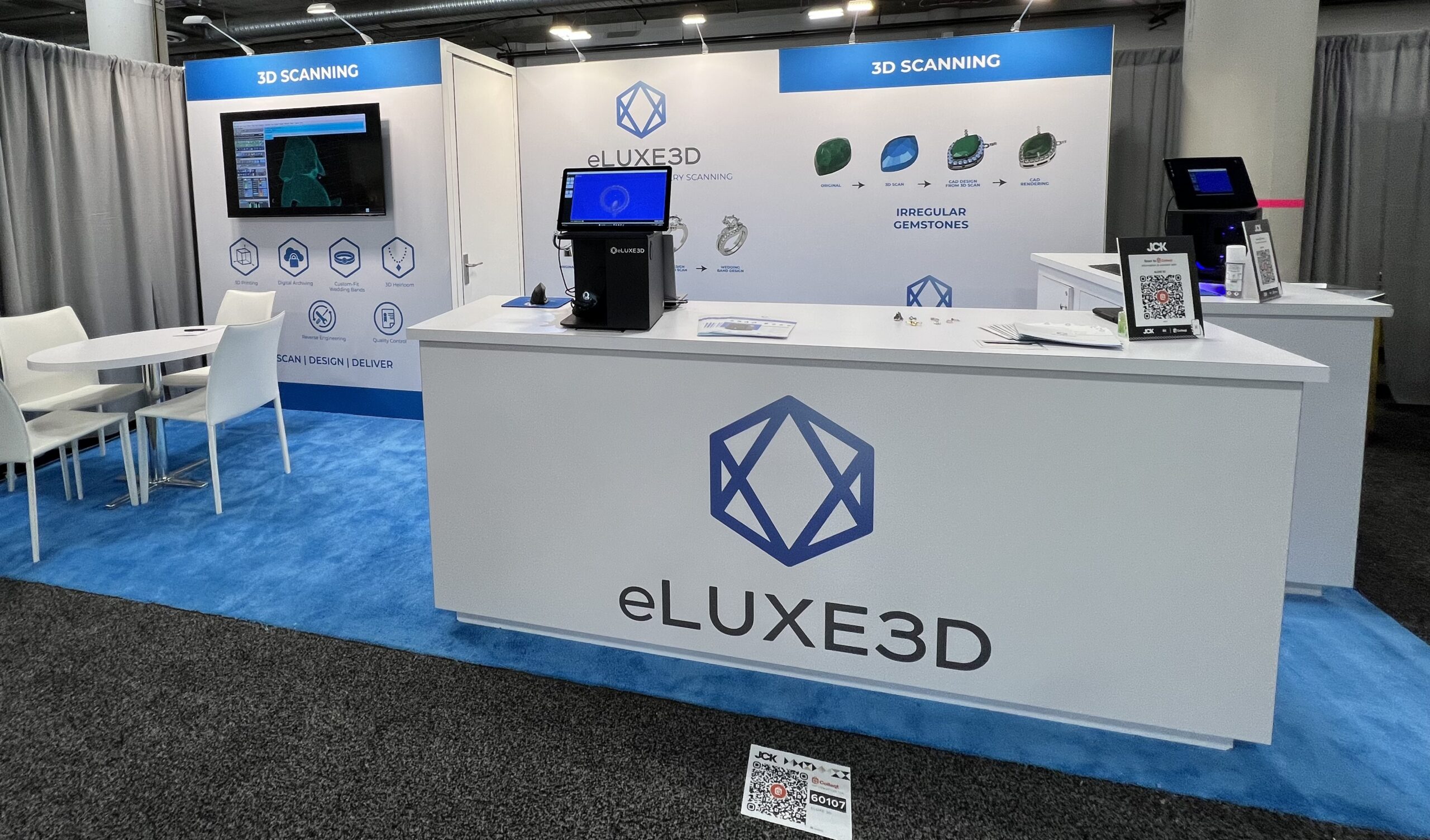
One of the most valuable aspects of eLUXE3D is the range of applications it can support across a jewelry business.
Custom-Fit Wedding and Shadow Bands
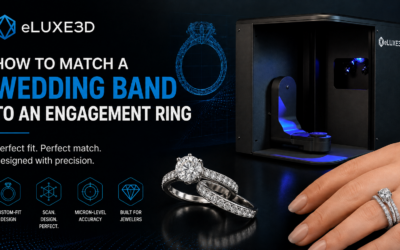
An engagement ring can be scanned to capture its contours, setting geometry, and relationship to the center stone. Designers can then use the resulting model to create a closely matched wedding or shadow band around the actual ring rather than relying only on manual measurements or approximations.
Irregular and Freeform Gemstones
Organic, asymmetrical, and uniquely cut stones can be difficult to recreate accurately in CAD. Scanning captures the true geometry of the gemstone, allowing the designer to develop bezels, prongs, and custom settings around the physical stone.
Restoration and Repair
Worn, damaged, or incomplete jewelry can be digitally documented before restoration begins. The scan provides a lasting reference for original proportions, decorative details, surfaces, and structural elements that may otherwise be difficult to record.
Heirloom Reproduction
Sentimental jewelry can be captured digitally and used as the basis for reproduction, resizing, modification, or modernization. This creates new possibilities for families that want to preserve an original piece while creating versions for future generations.
Jewelry Duplication
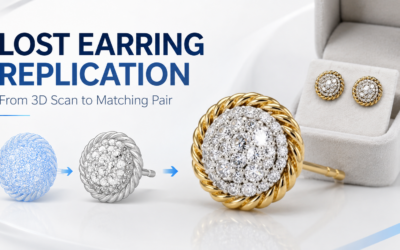
A scan can provide the precise geometry needed to reproduce a piece or component without rebuilding every detail manually. This is useful for repeat production, replacement pieces, coordinated sets, and designs that may need to be manufactured again later.
Digital Archiving
Retailers, designers, and manufacturers can create organized digital records of inventory, client jewelry, master models, or historically important pieces. Once archived, the scan can support future redesigns, insurance documentation, reproduction, or production needs.
Reverse Engineering and CAD Development
Existing jewelry can be brought into a digital environment for analysis, modification, redesign, or integration into a new concept. Instead of beginning from an empty CAD workspace, the designer can begin with the actual geometry of the object.
Quality Control
Scanned castings or finished components can be compared with their digital references to identify variations, shrinkage, warping, or other production concerns before they affect the final customer experience.
The Return on Investment Goes Beyond Scan Speed
The value of a jewelry scanner should not be measured only by how quickly it produces a model.
The larger return comes from the steps it can remove, simplify, or bring under your own control.
Saving Labor and Design Time
Manual measurement, tracing, molding, and rebuilding geometry in CAD can consume hours before the creative portion of a project even begins. Starting from accurate scan data allows designers to spend less time reconstructing what already exists and more time developing the finished piece.
Reducing Material Waste
Inaccurate measurements and incorrect assumptions can lead to failed prototypes, additional prints, remakes, poorly fitting components, and wasted casting materials. More reliable source data can help reduce avoidable trial and error.
Limiting Shipping and Insurance Costs
When a customer’s ring, gemstone, or heirloom must be sent to an outside designer, manufacturer, or scanning provider, the business may assume shipping expenses, insurance costs, administrative work, and the risk associated with transporting a valuable or irreplaceable object.
An in-house scanning process allows the physical piece to remain under the jeweler’s control while the digital file moves through the workflow.
Reducing Dependence on Outside Services
Outsourcing may be necessary when a business lacks the equipment required to complete a specialized task. However, repeatedly paying another provider to scan objects, prepare models, or recreate geometry can become expensive and may introduce scheduling delays.
Bringing scanning in-house gives the business greater control over timing, file management, customer communication, and quality.
Creating a Repeatable Internal Process
The greatest operational advantage may be consistency.
Once a scanning process is established, it can be repeated across employees, projects, and locations. Instead of relying on individual measuring techniques or rebuilding each piece from the beginning, the business gains a more standardized digital starting point.
That repeatability can support faster training, more predictable turnaround times, easier collaboration, and greater capacity as the volume of custom work grows.
Staying Competitive Without Losing What Makes Jewelry Personal
The jewelry industry is built around emotion, creativity, skill, and trust. Those qualities will not disappear as technology develops.
But the tools used to deliver the final result will continue to improve.
Businesses that adopt digital workflows are not abandoning the traditions of jewelry making. They are giving those traditions a more precise and scalable path forward.
By combining craftsmanship with accurate scan data, jewelers can protect important pieces, create more confidently, reduce unnecessary production steps, and offer services that may not have been practical within a completely manual workflow.
The objective is not simply to follow technology for the sake of appearing modern. It is to use the right technology to create better work and operate a stronger business.
Couldn’t Join Us at JCK 2026?
For everyone who visited us in Las Vegas, thank you again for making JCK 2026 such a meaningful experience for the eLUXE3D team.
For those who were unable to attend, the conversation does not have to end with the show.
Our team can walk you through the eLUXE3D scanning process, discuss your current workflow, and explore applications specific to your business. Whether you are focused on custom-fit bands, unusual gemstones, restoration, reproduction, archiving, reverse engineering, or improving production efficiency, we would be glad to show you what is possible.
Contact the eLUXE3D team to schedule a personalized demonstration and discover how precision 3D scanning can become part of your jewelry workflow.
Contact Us